
Backlink Campaign: How to Build Links That Actually Rank

Eliza Forgacs
In the ever-evolving world of SEO, backlinks remain one of the most powerful signals Google uses to determine rankings. Recent analyses show that pages ranking #1 in Google search results tend to have on average 3.8× more backlinks than those in positions 2–10. This is affirming just how critical it is to build the right backlinks for organic visibility in 2026.
In this guide, we’ll break down:
- exactly what a backlink campaign is,
- why quality backlinks still matter for SEO,
- how to find the right link opportunities with Ranking Raccoon,
and how to plan and execute a link building campaign that drives real results.
How to Plan a Successful Backlink Campaign?
Everything successful starts with a plan, and a backlink campaign is not an exception. You can’t just shoot emails blindly and follow a hurriedly put together link list. It won’t give you necessary conditions for growth, chances are they produce low-quality results.
We’ll break down how to plan a fruitful backlink campaign step by step, but before dipping into strategies of how to:
- Define measurable SEO goals
- Identify real link opportunities
- Create an outreach process that earns links
Let’s take a quick detour and understand the basics of what you’re actually planning.
So, what exactly is a backlink campaign?
Think of a backlink campaign like running a restaurant kitchen: you don’t just throw random ingredients into a pot and hope it turns out great; you follow a recipe, prep the right components, and execute with consistency.
The principle behind a backlink campaign in SEO is the same: it’s a planned, systematic effort to earn high-quality inbound links from other websites to your own.
It’s not buying a cheap package of links or spamming forums with your content. Your backlinks should work as votes of confidence that tell Google your content is authoritative and relevant—a key reason why strong backlink profiles still define top-ranking pages in 2026.
And unlike one-off actions, a link building campaign brings everything together under a clear objective. It’s the complex management of your link building efforts starting from defining goals, prospecting, SEO outreach and coordinated follow-ups.
Steps of a SEO backlink campaign
For a successful backlink campaign all you need is a structured plan you can follow! Think of it as your SEO playbook for earning links that actually move the needle.
Step 1: Define clear campaign goals
Before doing anything else, you need to define what success looks like. In SEO, there are three common types of goals in a backlink campaign:
- Links: Are you focused purely on earning referring domains?
- Traffic: Are you targeting links that send referral visitors?
- Rankings: Are you optimizing to move specific keywords up in Google?

Often, the highest impact campaigns aim for all three, but your launch strategy should start with clarity. Setting measurable campaign-level KPIs keeps you honest. These can include:
- Number of new backlinks earned per month
- New referring domains
- Organic traffic growth
- Keyword ranking improvements
Why is it important? Well, KPIs help you evaluate which parts of your campaign are working (and which need tweaking) long before you see ranking changes.
Step 2: Identify link opportunities
This is where your backlink campaign stops being theoretical and starts becoming actionable. Identifying link opportunities is about mapping where links already exist in your niche, and where your content naturally fits into that ecosystem.
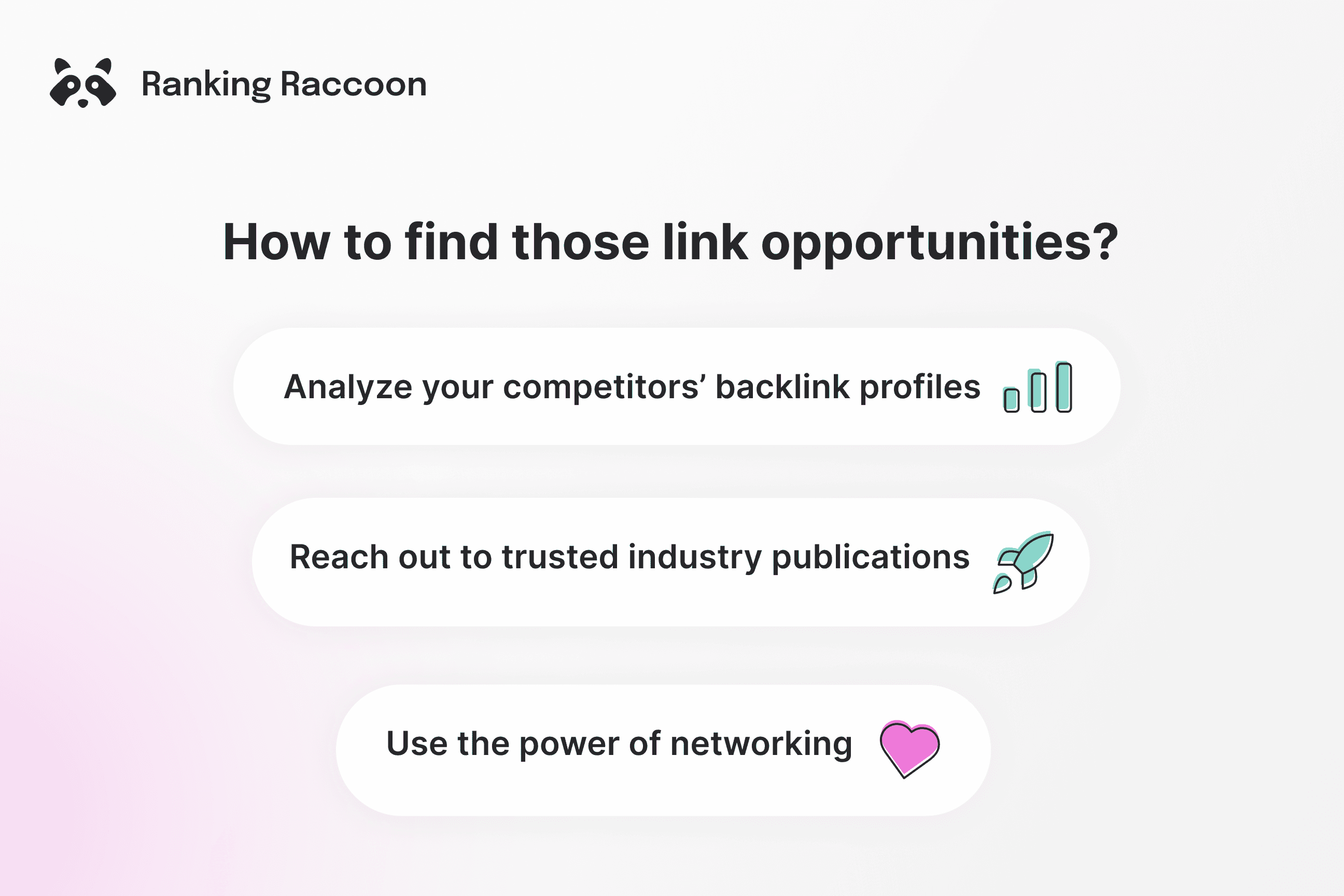
The three most reliable sources of high-quality link opportunities:
Competitor backlink analysis
One of the fastest ways to find link opportunities is to study what already works. If competitors are consistently earning links from certain sites, there’s a strong chance those sites are open to linking to similar (or better) content.
Competitor backlink analysis helps you:
- uncover proven link sources
- identify content formats that attract links
- prioritize outreach targets with a higher likelihood of success
SEO tools like Ahrefs, Moz, or Semrush make it fairly easy to surface these opportunities.
Industry publications
Industry blogs, online magazines, and curated resource pages are among the most valuable backlink sources you can target.
These sites:
- actively link out to authoritative content
- care about relevance and quality
- tend to drive both SEO value and referral traffic
Look for publications that already cover your topic area and regularly reference external resources. Those are prime candidates for editorial links.
Communities & networking
Some of the best link opportunities don’t come from formal outreach at all. They come from being present where real conversations already happen.
Industry forums, Slack groups, Reddit communities, and niche directories are spaces where practitioners actively share resources, discuss challenges, and reference useful content in context. These environments are built on mutual interest and intent: participants are there to collaborate, not to be pitched.
Curated link-building communities like Ranking Raccoon lower the friction even more by connecting site owners who are already open to link collaboration, making it easier to find relevant opportunities without spamming inboxes.

Step 3: Create content worth linking to
You can’t ask for links if you don’t have something worth linking to. Journalists, bloggers, and editors don’t link to average content, they look for things that add value to their own articles, such as:
- Original data and research. Nobody links to the bland summary everyone else already wrote.
- In-depth guides and tutorials. These are the resources people want to bookmark and reference.
- Tools, templates, infographics. Proven formats that are inherently valuable.
Many mediocre campaigns fail because they start with outreach instead of content. You need something link-worthy first, and then you build the campaign around it. If the content isn’t valuable and informative on its own, no amount of outreach will make it perform.
"That’s why picking the right tactics is crucial. If you’re in B2B, think data reports, whitepapers, and thought-leadership guest posts. If you’re B2C, focus on free tools, comparison guides, and “how-to” tutorials. Copying another SaaS blindly won’t work—you need to adapt proven tactics to your niche and audience."
Learn more: SaaS Link Building: 10 Best Examples and Proven Strategies.
Step 4: Backlink outreach (done right)
This is where most campaigns live or die. Outreach is the process of contacting other website owners, editors, and content creators to earn a backlink. But be aware: don't spam others mailboxes, your main goal must be relationship building.
- Be personal!
Personalization doesn’t mean writing every message from scratch. It means referencing specific aspects of someone’s site (a particular article), so your message feels more human, relevant and thoughtful.
- Offer value upfront (tell them why their audience benefits).
- Use decent tools and workflows like Ranking Raccoon.
- Don't forget the power of follow-ups.
The Main Types of Backlink Campaigns
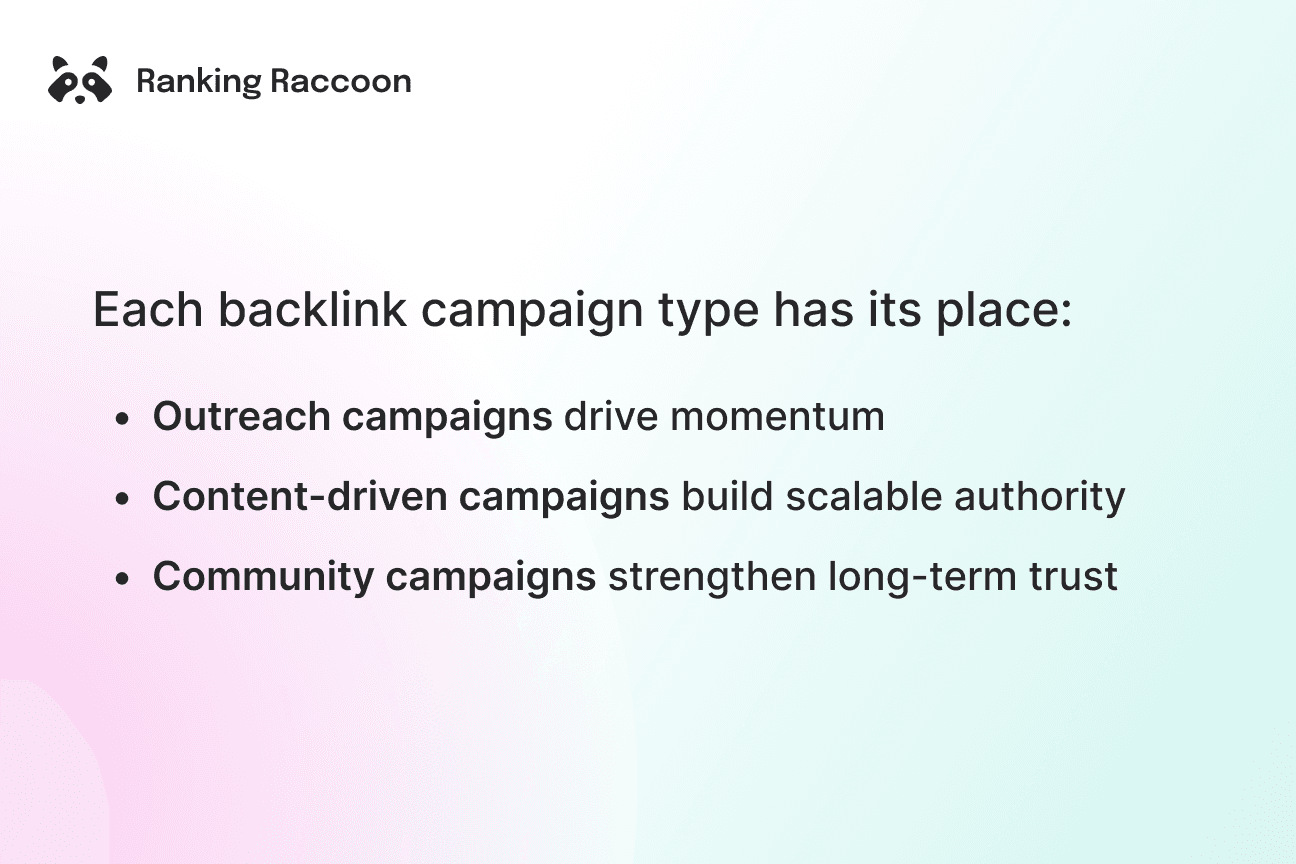
Different goals require different approaches. Some backlink campaigns focus on scale, others on authority, and some on long-term brand trust. The most successful SEO teams don’t rely on a single tactic; instead, they combine multiple campaign types into a balanced link building strategy.
Below you can learn more about the three main backlink campaign models:
1. Outreach-Based Backlink Campaigns
Outreach-based campaigns are the most direct form of link building. You identify relevant websites, reach out to them, and pitch a reason why linking to your content makes sense. Think of this as SEO networking: you’re starting conversations, not firing off link requests.
Cold email outreach
Cold outreach is exactly what it sounds like; contacting people who don’t yet know you. When done poorly, it feels like spam. When done well, it feels surprisingly relevant.
Effective cold outreach:
- Is highly targeted (right site, right content, right timing)
- Clearly explains why your content adds value
- Respects the recipient’s time
Cold outreach works best when you already have a strong asset and a tightly curated prospect list. Scale without relevance quickly kills results.
Push the big red “easy” button: try Ranking Raccoon and browse only highly relevant, high-quality websites that are open to collaboration.
Relationship-driven outreach
Relationship-driven outreach plays the long game. Instead of asking for links immediately, you focus on:
- Engaging with content creators over time
- Sharing and referencing their work
- Building familiarity before pitching
These campaigns usually convert better and lead to repeat links over time. While slower to start, they’re far more sustainable, especially in competitive niches where editors receive dozens of pitches per week.
Editorial placements
Editorial backlinks are earned when your content is cited naturally within articles, guides, or news pieces. These links are even more powerful because:
- They’re contextually relevant
- They’re difficult to manipulate
- Google strongly trusts them
Editorial placements often result from a mix of outreach, PR-style pitching, and content that genuinely deserves to be referenced (especially data-driven or expert-level material).
Content-Driven (Linkable Asset) Campaigns
Content-driven campaigns flip the traditional outreach model on its head. Instead of asking “Can I get a link?”, you create assets so useful that people want to link to them on their own, and outreach simply accelerates distribution.
That said, this approach can be riskier: it requires more upfront effort and there’s no guarantee the asset will attract links without strong promotion and timing.
Data studies
Original research is one of the strongest link magnets in SEO. Surveys, industry reports, and proprietary data give journalists and bloggers something rare: a primary source. These assets often earn links passively over months or even years because they’re repeatedly cited.
Ultimate guides
Ultimate guides aim to become the reference piece for a topic. They work best when they:
- Go deeper than anything currently ranking
- Are well-structured and easy to reference
- Answer questions competitors ignore
When successful, these guides can become natural backlink hubs.
Tools & templates
Tools, calculators, templates, and checklists are inherently linkable because they save time and reduce friction. People link to them not just to support a claim, but to help their readers. This makes them especially effective in B2B, SaaS, and SEO-related niches.
Your blog can be a key part in your SaaS SEO strategy—it’s ideal for attracting organic traffic, educating your audience, and showcasing your expertise. Remember to focus on E‑E‑A‑T (Experience, Expertise, Authority, Trustworthiness) to build credibility and trust with both readers and search engines.
Learn more while reading our B2B SaaS SEO Checklist.
Community Backlink Campaigns
Community-based campaigns focus less on outreach and more on presence. Instead of pitching links, you participate in places where your audience already spends time. Examples include:
- Industry Slack or Discord groups
- Specialized forums
- Reddit communities (when handled carefully)
Links from these environments are often nofollow, but their value goes beyond pure SEO. They drive referral traffic, brand recognition, and secondary linking opportunities when others discover your content.
Ethical participation vs spam (just a few tips):
Community backlink campaigns only work if you respect the space.
- Contributing before promoting
- Sharing content only when it genuinely answers a question
- Avoiding self-promotion disguised as “help”
Spam destroys trust quickly. And once that happens, both your links and your brand loose credibility.
Over time, consistent participation positions your brand as a trusted voice, helpful resource, and go-to reference. Think of it like an "authority-investment."
Backlink Campaigns with Ranking Raccoon
Backlink campaigns break down for one simple reason: most teams spend more time hunting for prospects and chasing replies than actually building links.
Ranking Raccoon is designed to remove that operational drag by turning link building into a curated, spam-free networking workflow. Instead of scraping lists and sending cold emails into the void, you can:
- browse a manually vetted pool of sites,
- filter by niche relevance and metrics,
- and message site admins directly inside the platform—because everyone there is explicitly open to link collaboration.
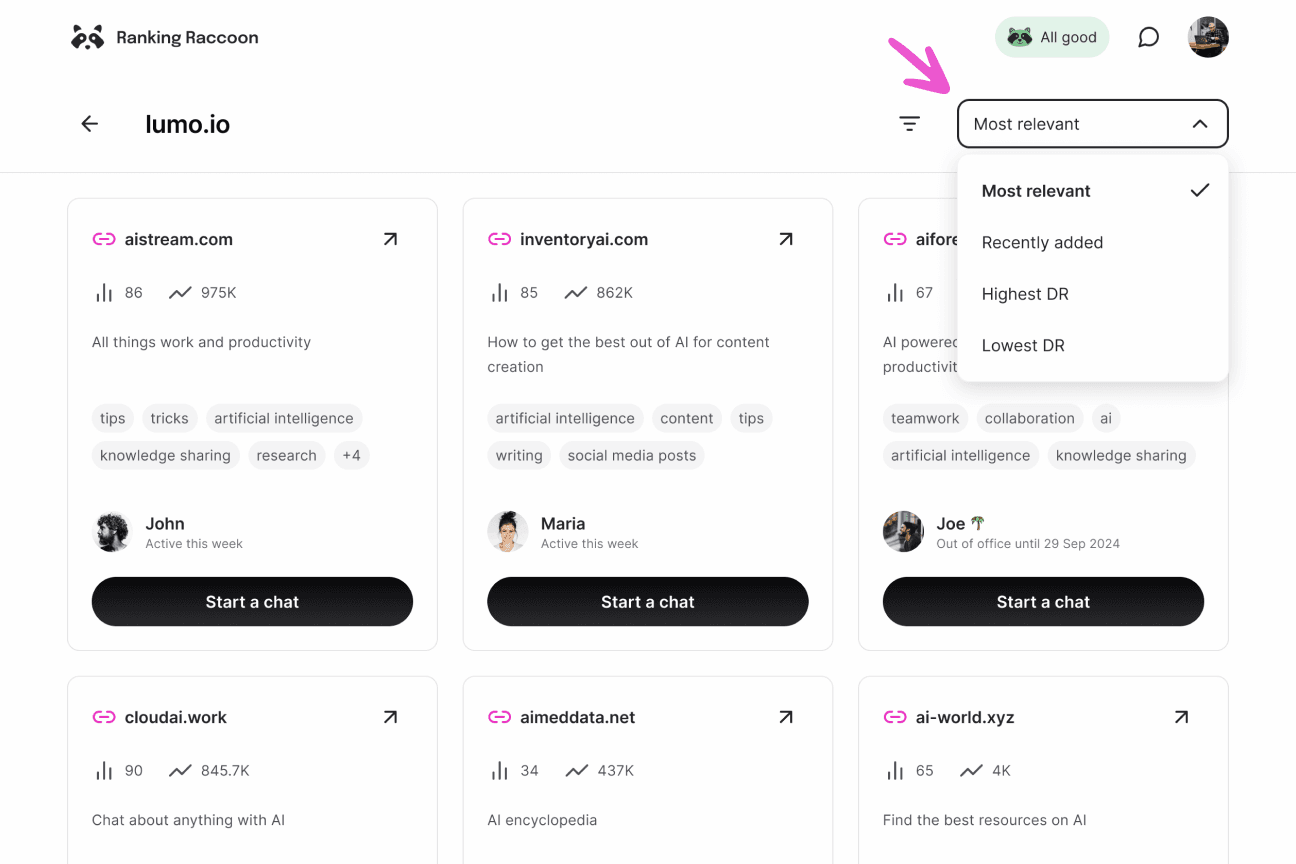
For campaign execution, this matters: faster prospecting means faster iteration. Ranking Raccoon highlights relevant partners and placements without the “million tabs” routine, and it even supports more precise placement discovery through features like keyword-based page finding (so you’re not pitching a homepage link when you actually need a contextual placement on a ranking article).
Ranking Raccoon doesn’t replace strategy, but it compresses the messy middle: vetted partners, faster prospecting, and direct communication, so your backlink campaign can focus on what actually moves the needle: relevance, context, and trustworthy placements.

Common Backlink Campaign Mistakes to Avoid
Backlink campaigns fail for the same reason most “quick wins” fail in SEO: they confuse activity with impact. Here are the most common mistakes, in a way your future self (and your inbox) will thank you for.
1) Chasing link quantity like it’s Pokémon
“Gotta catch ’em all” is a fun mindset… until you realize half your links are irrelevant, sitewide, or sitting on pages no one visits. One contextual, niche-relevant editorial link can outperform 30 random ones.
Fix: prioritize relevance + placement, not raw counts.
2) Starting outreach before you have anything link-worthy
If your content is basically “What is X? Here’s a 101 summary,” your outreach email is just a polite request for charity. And link building nowadays is… not big on charity.
Fix: build a linkable asset first (data, tool, template, definitive guide), then outreach becomes distribution.
3) “Dear Sir/Madam” outreach (aka: the instant delete button)
Generic templates are easy to send and even easier to ignore. If your email could be sent to 500 sites without changing a single word, it will perform like it.
Fix: add real personalization: mention a specific article, point to a specific placement, and explain why your asset helps their readers.
4) Pitching the wrong page (homepage syndrome)
You’re asking for a link to your homepage… but their article is about a specific subtopic. That’s like recommending a whole supermarket when someone asked where to buy oat milk.
Fix: pitch the most relevant URL, and suggest the exact section where the link fits.
5) Ignoring follow-ups (aka: “I sent one email, guess it’s over”)
Most replies don’t come from the first email. People are busy, inboxes are chaos, and your pitch isn’t their top priority.
Fix: follow up 1–2 times, politely, with added context.
6) Over-optimizing anchor text like it’s 2012
If you push exact-match anchors everywhere (“best backlink campaign software”), it looks unnatural fast. Editors notice. Google notices. And your link profile will start to look fake.
Fix: keep anchors natural (brand, partial match, contextual phrasing).
7) Targeting irrelevant sites because the metrics look shiny
A high-metric site in the wrong niche is like shouting through a megaphone in an empty parking lot. Loud… but pointless.
Fix: filter by topical relevance first, metrics second.
8) No tracking = “spreadsheet archaeology” later
If you don’t track who you contacted, what you pitched, and which links went live, you’ll end up digging through old emails for long-long hours.
Fix: track campaign status (prospect → contacted → replied → live link → verified), and review weekly.
9) Measuring success only by “links built”
Links are leading indicators. The real win is improved rankings, visibility, and qualified traffic.
Fix: define campaign-level KPIs: referring domains, link quality, keyword movement, organic clicks (GSC), and conversions where relevant.
Final Thoughts: Building Backlinks That Scale With SEO
Backlink campaigns aren’t about collecting links like souvenirs. They’re about building systems that scale with your SEO goals. When done right, links compound: each strong placement makes the next one easier, each campaign sharper, and each result more predictable. The difference between “we built some links” and “our rankings actually moved” almost always comes down to structure, relevance, and follow-through.
That’s also where tools like Ranking Raccoon fit naturally into the process. By giving you access to vetted sites, and direct conversations with site owners it helps turn backlink campaigns into proven and repeatable workflows.
Build less noise. Build more impact. Happy link-building!
Eliza Forgacs
Marketing Manager