
The Strongest Backlinks Revealed: Best Link Building Strategies for 2026

Eliza Forgacs
Here’s a fun stat: pages ranking in Google’s #1 spot have an average of 3.8× more backlinks than positions 2–10.
Shocking? Sure. Misleading? Absolutely.
Because in 2025, Google couldn’t care less about your raw backlink count. It is still caring about different numbers, like whether those links come from trusted sites or PBNs. Or questions like; “Is this link placement actually useful?” have emerged.
The strongest backlinks are the ones that hit the holy trinity: relevance, context, and real traffic. Add trust, authority, and non-spammy editorial placement, and you’ve got the kind of links Google actually values.
In this article, we’ll walk you through:
- what the best backlinks really are,
- how strong vs. weak backlinks differ (hint: it’s not DA),
- how Ranking Raccoon can help you to build strong, high-quality backlinks,
- and the best backlink builder strategies that work in 2026.
If you're ready to stop chasing vanity metrics and start building the kind of links that move the needle, let’s dive into the truth about backlink strength.
How to Define Your Strongest Backlinks?
To answer your question in the simplest way possible: Your strongest backlinks are the ones that leave a serious impact on your ability to rank.
These are the ones that send the clear, interpretable signal to Google:
“This page is trustworthy, relevant and worth showing to users.”
What Makes a Backlink “Strong”?
To dive deeper into what qualities create a strong backlink, we need to understand that the best links meet multiple quality signals at once. They’re built with precision, relevance, and genuine editorial intent.
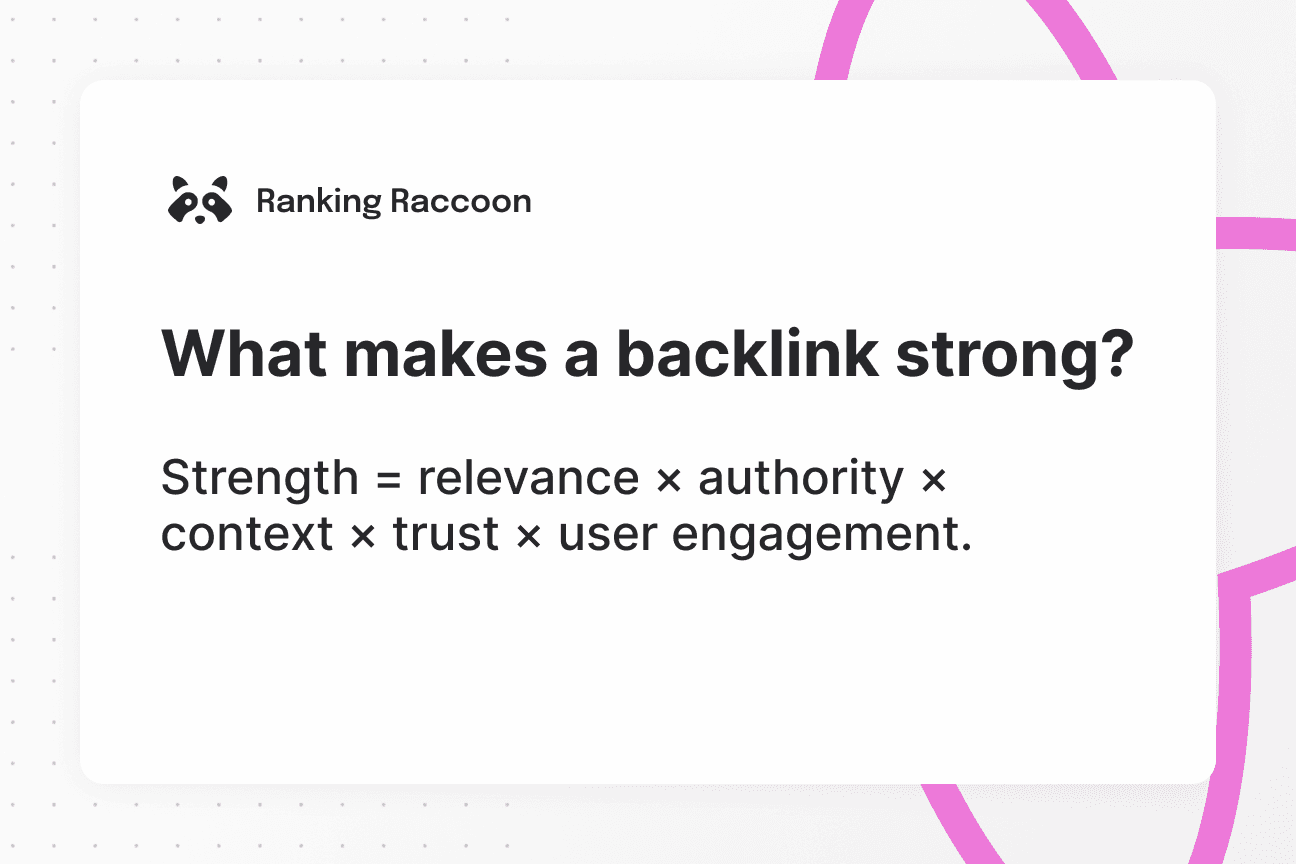
In other words: strength = relevance × authority × context × trust × user engagement.
Let’s break down the components of the backlinks that will actually move the needle in 2026.
Key Factors of Best Backlinks
So what actually separates high-quality backlinks from the countless links that look fine on paper but barely move the needle in search rankings?
Five key factors—it’s all it comes down to. A handful of measurable, data-based signals that determine your backlink’s strength.
Good to know: Google has become exceptionally skilled at evaluating these signals, combining relevance, context, trust, and user behaviour into a clear understanding of which links deserve ranking power.
Below are the 5 core factors that consistently define the strongest backlinks in 2026.
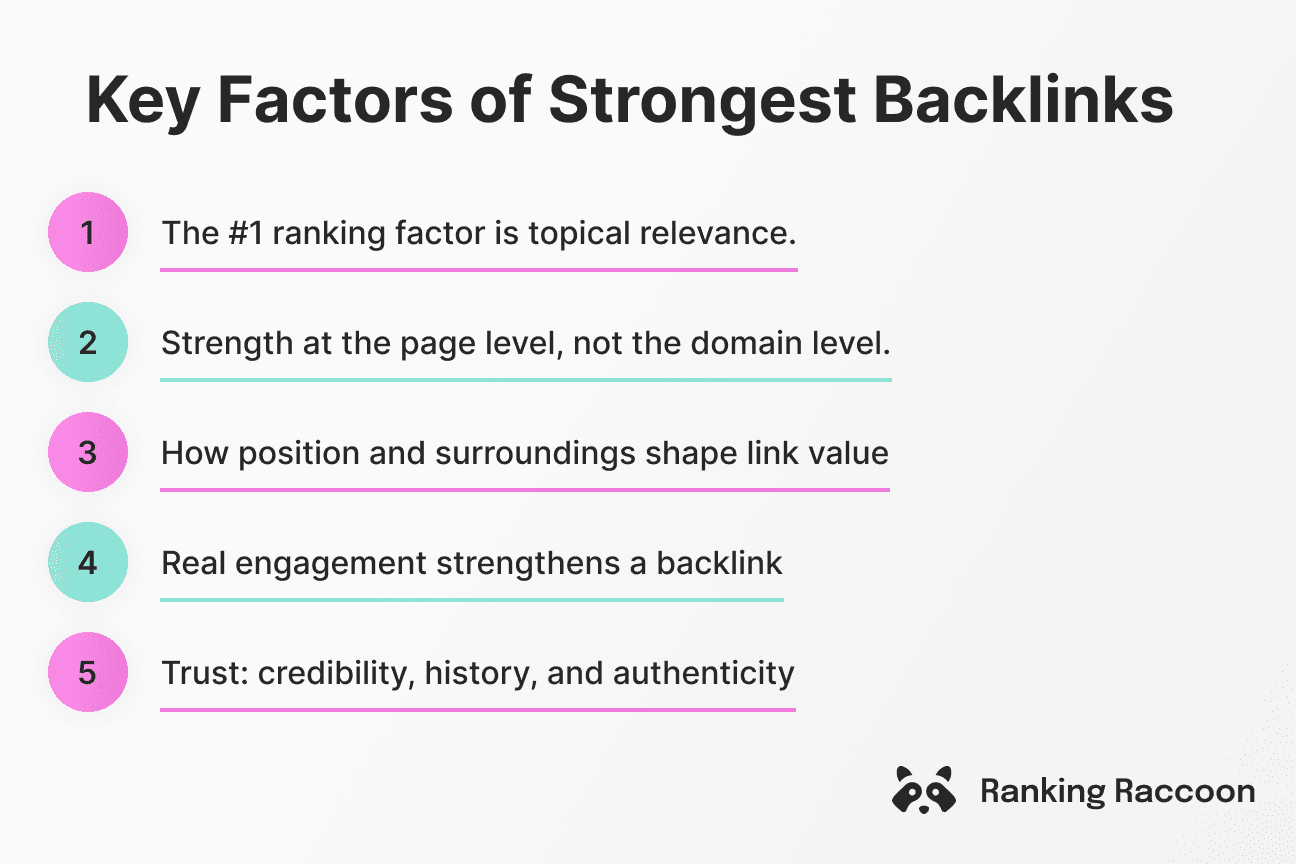
The #1 ranking factor is topical relevance.
It means the linking page and your page belong to the same thematic neighborhood and the link contextually makes sense.
Since Google now uses:
- semantic topic clustering (so basically it can group content by meaning),
- entity relationships (check how different brands or topics connect to each other),
- contextual embeddings (understand how a link fits within the page’s overall context),
It’s basically impossible to trick its algorithm.
Strength at the page level, not the domain level
Often called Referring Page Authority (notice we said page, not domain), this principle focuses on the strength of the individual page linking to you.
DA or DR can be useful signals, but remember; neither of them is a Google metric. They’re third-party approximations.
Instead, what actually determines the value of a backlink is the credibility and performance of the linking page itself.
- Does the page have strong, relevant backlinks of its own?
- Does it rank for meaningful keywords?
- Is it recognized as a resource within its industry or topic area?
- Has it earned trust and topical relevance over time?
This is why a well-optimized, niche-relevant DR 20 page with real traffic can outperform a DR 90 page that hasn’t had an engaged visitor in years!
How position and surroundings shape link value: Placement & context
Not all link placements carry the same weight. A backlink buried in a footer or sidebar carries far less weight than one placed naturally within the body of well-written topic-aligned content.
Google considers several contextual signals when evaluating a link:
- on-page location (above-the-fold placements typically carry more weight),
- editorial context (is the link surrounded by meaningful, related content?),
- anchor text relevance,
- semantic alignment between the paragraph and the linked page.
When a link sits within a meaningful sentence, supported by helpful, topic-aligned content—Google interprets it as a genuine editorial endorsement. But when it’s placed among dozens of generic outbound links, it’s far less impactful.
Real engagement strengthens a backlink: Traffic & user signals
Beyond context and authority, Google also observes how users interact with the linking page and the link itself. This is where actual engagement starts to matter.
These signals include:
- clicks on the backlink,
- long dwell time after the click,
- repeated co-visitation patterns,
- overall traffic and activity on the referring page.
When real users treat a link as it has true value, Google interprets it as a sign of topical and editorial relevance. That said, a backlink that receives zero engagement may still count, but a link that attracts consistent traffic sends far stronger ranking signals.
Trust: credibility, history, and authenticity
Finally, trust determines whether a backlink is treated as a legitimate vote of confidence or just another digital artifact.
What can signal trustworthiness to Google (and users)?
- the site’s overall spam history and long-term reputation,
- the demonstrated credibility, expertise, and consistency of its authors,
- the editorial rigor and quality standard applied to published content,
- natural, topic-aligned outbound linking patterns that reflect genuine recommendations,
- and the absence of manipulative linking practices or identifiable network footprints.
A backlink from a well-maintained, credible site reinforces your authority. A backlink from a domain with questionable history can dilute it.
Why DA Doesn’t Define the Strongest Backlinks (Industry Myth Debunked)
There’s persistent confusion which formed itself into a myth: High DA = high link power. But that’s not how modern backlink strength works!
First of all, Domain Authority is not a Google metric. It comes from a third-party SEO tool, called Moz. It’s not used by Google itself, although it is used to predict how likely a site is to rank in the SERP.
The strongest backlinks draw their value from a combination of factors which we discussed earlier in detail:
- topical relevance,
- page authority,
- editorial context,
- real user engagement,
- non-spammy authority and trust.
So, a backlink from a modest site that checks all these boxes (even with a DA of 25) can far outperform a backlink from a high-DA 80 site if that latter link is irrelevant, hidden in a low-value page, or never attracts real users.
Why strong DA ≠ strong outcome
Relying purely on DA (or similar scores) can lead to investments in links that look impressive in an SEO report, but deliver little to no actual ranking benefit. In contrast, prioritizing relevance, context, engagement and trust yields far higher ROI, and ensures stability against algorithm updates that devalue superficial link metrics.
Build The Strongest Backlinks
If you want to build the strongest backlinks, you need more than an enormous outreach list or a pile of generic guest posts. Strong links are the result of smart targeting, thoughtful content, and a deep understanding of what Google values today. This is where the most effective backlink strategies of 2026 begin.
The Ranking Raccoon Way of Getting Relevant Backlinks
Ranking Raccoon is a purpose-built networking community for link builders, SaaS companies, marketers, and website owners who want to exchange backlinks in a safe, transparent, and efficient way.
- No spam.
- No shady marketplaces.
- No endless cold outreach.
Just reliable collaboration between real people with real websites.
Every domain in the community is manually vetted, ensuring members only connect with credible, relevant sites rather than random URLs scraped from a database. This alone removes hours of manual filtering, quality checks, and trial-and-error outreach.
Ranking Raccoon’s advanced filtering system makes discovering potential link placements significantly faster. You can sort websites by niche relevance, DR range, or recency. For more precise targeting, the Pages feature allows you to search individual URLs by keyword to find ideal contextual matches within published content.
The platform also includes built-in chat messaging, so link builders can coordinate placements, exchange anchor text, clarify requirements, and finalize links directly inside the system—eliminating the delays and low response rates that come with traditional outreach.
The result?
Prospecting becomes faster, cleaner, and dramatically more efficient. Tasks that used to take days can now be completed in minutes, allowing you to focus your time and energy on strategy and execution rather than chasing replies or sorting through unreliable prospects.
Best Backlink Builder Strategies
When it comes to building the strongest backlinks, tactics matter just as much as targets. In 2026, the most effective strategies share a few things in common: they’re value-driven, relevance-first, and built to last through algorithm updates.
Here are the core strategies that consistently earn high-quality backlinks.
Build linkable assets that naturally attract references
Instead of begging for links to every blog post, create content that people want to reference:
- original data studies,
- industry reports,
- benchmark articles,
- interactive tools, calculators, or checklists,
- in-depth “ultimate” guides.
Okay, let’s be honest: even the best content rarely earns links on its own unless you’re already a large, established brand. Most websites still need outreach to get their assets in front of journalists, bloggers, and industry partners.
What strong linkable assets do is make that outreach dramatically more successful. When you offer something genuinely useful, people are far more willing to link back, mention your work, or exchange placements.
Leverage digital PR for authoritative mentions
Digital PR connects your brand with high-authority publications and niche media. This usually involves:
- pitching data or insights to journalists,
- offering expert commentary on trending topics,
- responding to journalist request platforms (HARO-style tools),
- publishing thought leadership content that supports stories and analyses.
The result: editorial backlinks from credible sites that strengthen both your brand and your overall backlink profile.
Use strategic, relevance-first guest posting
Guest posting still works, if done with intention. Keep your key focus on:
- websites that are clearly relevant to your topic or industry,
- audiences that overlap with your target users,
- editorial-quality articles that add value, not just hold a link.
Done right, each guest post can become a strong contextual backlink, an addition to your brand’s visibility, and a relationship-building opportunity with publishers in your niche.
Secure high-quality niche edits on traffic-carrying pages
Niche edits (alias contextual links added to existing content) can be extremely effective when:
- the page already ranks and gets traffic,
- your link genuinely improves the content,
- the referring site has solid trust and topical alignment.
You’re essentially plugging into existing authority and traffic instead of starting from scratch. The key: avoid low-quality “link insertion services” and focus on real editorial updates on legitimate sites.
Tap into community-driven link opportunities
Communities are underrated backlink sources. Industry forums (if well moderated), Slack or Discord communities or LinkedIn groups can hide some treasures. Ranking Raccoon is also a community-based networking platform where the key is to build lasting link building partnerships.
Use tiered link structures to support top-tier links
Tiered link building is based on a straightforward principle: when a page gains more authority, it passes more authority through its outbound links.
- Tier 1 includes your strongest and most valuable backlinks. These are typically editorial links, contextual placements, and top-tier mentions from authoritative, relevant sites.
- Tier 2 consists of supporting links that point to those Tier 1 pages, such as guest posts, mentions, citations, and social signals that help strengthen the authority of the pages linking to you.
The idea is to reinforce the authority of pages that already link to you, helping them rank better, so the value flowing to your site increases as well.
Red Flags of Low-Quality Backlinks
By this point, you’ve seen what a strong backlink looks like, but it’s just as important to recognize the ones that pretend to be useful while quietly working against you.
Before you celebrate every new link in your profile, here are the warning signs that should make you pause, inspect, and possibly back away slowly:
- Link farms: Networks of low-quality sites created solely for the purpose of linking out. They offer no real content, no audience, and no editorial oversight.
- Paid link networks: Sites that sell links at scale often have unnatural outbound link patterns, thin content, and footprints that make them easy for Google to identify and devalue.
- No-traffic websites: If a site receives little to no organic traffic, it’s a sign that Google doesn’t trust its content — meaning its links won’t carry meaningful value.
- Home page–only links: When a domain links exclusively from its home page to dozens of external sites, it typically indicates a directory-style setup or a manipulative linking tactic.
- Exact-match anchors: Over-optimized anchors like “best plumbing services Boston” used repeatedly across low-quality sites are a major red flag. Natural anchors vary in wording and tone.
Low-quality backlinks may look harmless at first, but accumulating too many can dilute your authority and signal risk to search engines. Staying aware of these red flags helps you build a backlink profile that is both strong and sustainable.
The Strongest Backlinks: Key Takeaways
If there’s one thing to remember from this guide, it’s this: the strongest backlinks aren’t defined by a single metric and definitely not by DA alone. What truly matters is the combination of relevance, authority, context, trust, and real user engagement. When these elements align, a backlink becomes more than a hyperlink; it becomes a meaningful signal of credibility in Google’s eyes.
Strong backlinks demand thoughtful strategy, selective outreach, and partnerships with reputable sites. This is exactly where Ranking Raccoon becomes invaluable: by helping you connect with vetted, relevant websites, discover contextual link opportunities faster, and build collaborations that actually strengthen your backlink profile.
When you focus on the right pages, the right context, and the right relationships, your backlink strategy becomes a long-term competitive advantage, one that survives algorithm updates and supports sustainable growth.
That’s how you earn the strongest backlinks in 2026 and beyond.

FAQ
Which backlink is the most powerful?
The most powerful backlink is a contextual, editorial link placed naturally within relevant, high-quality content on a topically aligned page with real authority and traffic.
Relevance + context + trust + engagement consistently outperform high-DR but irrelevant or low-quality placements.
What is a high-quality backlink?
A high-quality backlink is one that:
- comes from a credible, trustworthy, real website,
- is embedded within meaningful, topic-aligned editorial content,
- is indexable and contextually relevant,
- can send actual traffic,
- and uses natural anchor text.
It's the combination of these factors, not a single metric that determines true quality.
How do you build strong backlinks?
You build strong backlinks by focusing on relevance, editorial value, and trust, not on quantity. Some effective methods:
- creating linkable assets that improve outreach success,
- leveraging digital PR for authoritative mentions,
- guest posting on niche-relevant sites,
- securing high-quality niche edits on traffic-generating pages,
- collaborating through vetted communities like Ranking Raccoon,
- and reinforcing top-tier links with strategic Tier 2 support.
The key is consistency and focusing on placements that genuinely help users.
What are top-tier backlinks?
Top-tier backlinks are the highest-value links you can earn. These are:
- contextual editorial links on authoritative, niche-relevant pages,
- placements on trusted industry publications or “power hubs,”
- links from pages with real traffic, engagement, and strong page-level authority.
They are the links that most significantly influence rankings, and the ones worth prioritizing in any long-term link strategy.
Eliza Forgacs
Marketing Manager