
Backlinks Management for SEO Pros: The 2026 Playbook

Eliza Forgacs
The websites scaling rankings aren’t just building backlinks. They’re managing them like assets, always monitoring, tracking, controlling and re-prioritising.
Your competitors are ranking high because they learned exactly which backlinks matter and how to maintain a better backlink profile. They likely handle backlinks management as a core part of their SEO strategy.
But worry not, my raccoon friend, this article gives you:
- An exact backlink management framework to follow,
- Tips on tools high-performing SEOs use,
- KPIs that truly matter when managing backlinks,
And everything to keep your backlink profile clean, growing, and strategically aligned with your business goals.
Backlinks Management as Your 2026 SEO Advantage
Effective backlinks management can be the competitive edge separating stable rankings from constantly battling drops. Google’s link evaluation system has evolved dramatically in recent years, with spam detectors reinforced by AI technology, harder-to-pass domain trust assessments, and critically important E-E-A-T signals, just to name a few.
So, when Google takes a look at your backlink profile in 2026, it better sees relevance, authenticity and long-term stability.
Link volume alone no longer drives growth. What matters is whether your backlinks remain relevant, clean, and structurally sound over time. Without management, profiles decay quietly: links are lost, toxic domains creep in, anchor text drifts out of balance, and trust erodes until rankings become unstable or collapse outright.
Backlinks must now be treated as ongoing strategic assets, not one-off wins. Like any investment, they demand consistent monitoring, evaluation and prioritisation if you want them to continue delivering SEO returns.
Backlink Management in a Nutshell: Essential Clarifications
Before we dive deeper into frameworks and workflows, let’s quickly clarify the core concepts behind backlink management. Even seasoned SEOs benefit from aligning on terminology, especially now, when changes in the digital landscape are faster than ever.
What is a backlink?
A backlink is a hyperlink from one website to another. Sounds pretty straightforward, but in SEO, it’s far more than a simple connection. A backlink acts as a signal of trust, authority, and relevance, helping search engines understand which pages deserve visibility.
In practice, a good backlink tells Google:
“This page provides value and I vouch for it.”
A bad backlink, however, may imply manipulation or low-quality associations. That’s why backlink management matters.
What exactly is backlink management?
Backlink management is the ongoing process of tracking, evaluating, improving, and safeguarding your backlink profile.
In the strict sense, it’s everything that happens after a link is acquired. But in the broader SEO reality, backlink management overlaps with link building itself. Every outreach, every placement, and every anchor choice influences the long-term health of your entire backlink ecosystem.
The undeniable truth is that backlink management should be a continuous cycle that includes:
- Auditing existing backlinks for quality, relevance, and risk
- Monitoring new, lost, or suspicious links
- Identifying toxic or spammy backlinks
- Maintaining a balanced, natural anchor text profile
- Reclaiming lost or broken links
- Prioritising the most impactful opportunities
- Ensuring your backlink profile aligns with Google's evolving guidelines
The best SEOs treat this as a core strategy, not something they just mingle-mangle once a quarter.
Why is backlink management important?
In a sense, backlinks are like living assets; they’re gaining or losing value over time. Search engines are keeping a keen eye on:
- Where they come from
- How they were earned
- Whether they remain relevant
- Whether the linking page changed
- Whether the anchor text signals trust or manipulation
- Whether the link decays, breaks, or gets removed
When a backlink profile is poorly managed, these factors silently accumulate risk: disappearing or redirected links dilute authority, toxic links undermine trust, over-optimized anchors trigger algorithmic suspicion, and Google’s link spam updates create ranking volatility or slow organic decay even without visible penalties.
In contrast, a well-managed backlink profile becomes a stabilising force; delivering greater ranking consistency, stronger topical authority, faster recovery from algorithm updates, healthier E-E-A-T signals, and predictable, compounding organic growth over time.
Not such a hard choice, right?
The Modern Backlinks Management Framework (2026 Edition)
How do high-performing SEO teams do it? They don’t leave backlinks to chance, that’s for sure! They follow a structured operational workflow that keeps their profiles clean, stable, and strategically aligned with growth.
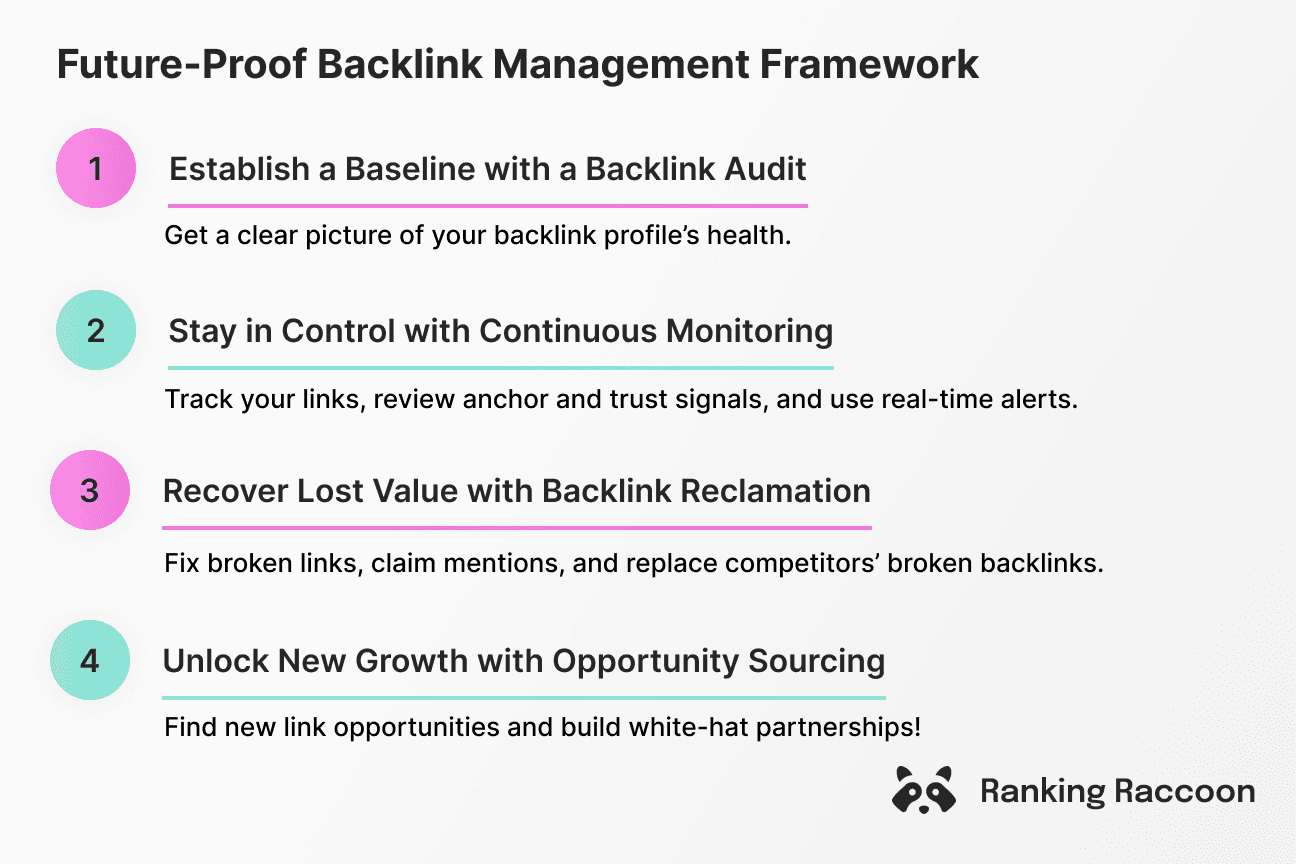
1. Establishing a Baseline with Backlink Audit
A backlink audit is the foundation of every strong backlink management program. It reveals what you’re working with, what’s helping you, and what’s silently dragging your rankings down.
I prefer using Ahrefs for this, but similar SEO tools work. What matters is following a clear, repeatable process. Here’s the step-by-step system I use:
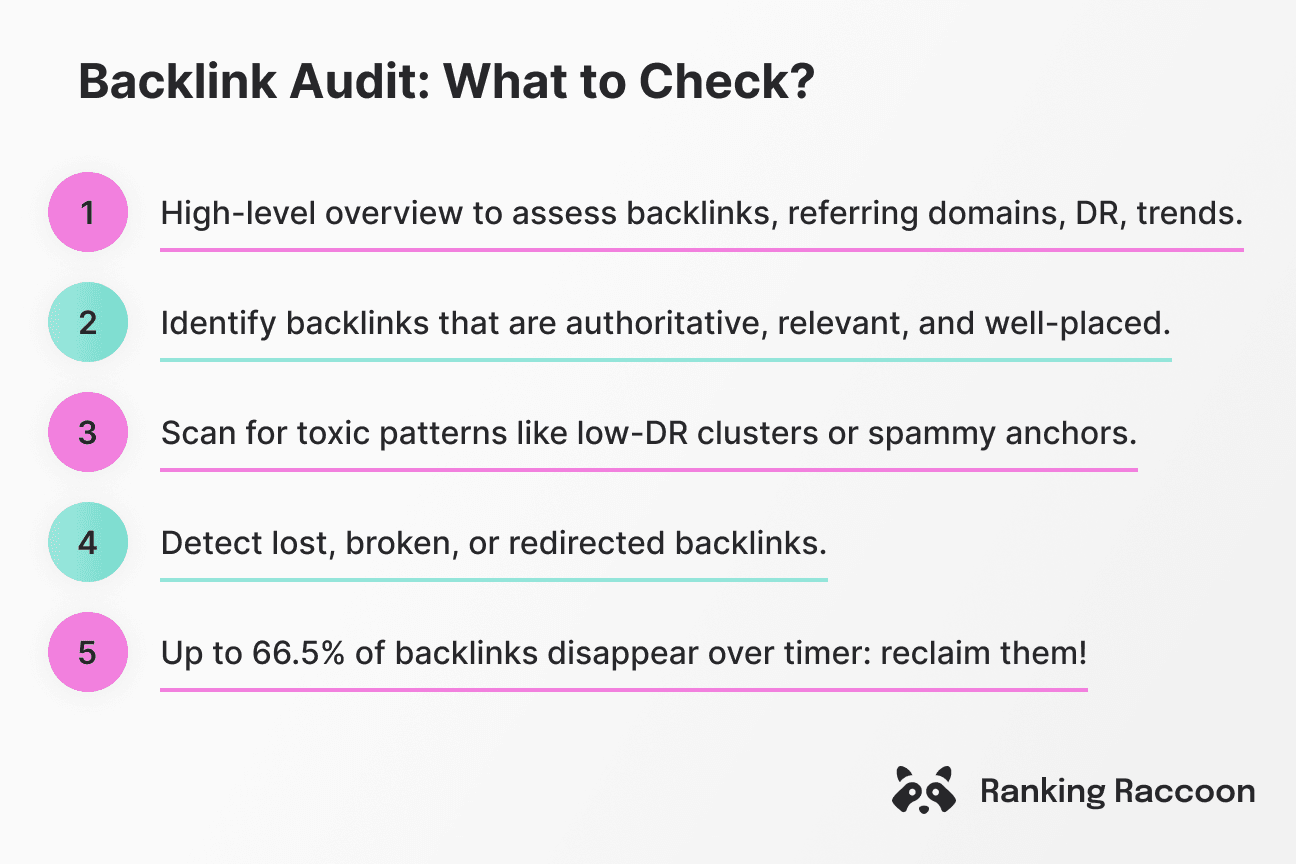
High-level view in Site Explorer
First, you’ll need an overview of your full system. Kick things off in Ahrefs Site Explorer. Plug in your domain, and pull up the full picture; every subpage, every link, nothing hidden.
In one dashboard, you’ll see your:
- total backlinks
- referring domains
- DR
- backlink growth chart (spikes, drops, anomalies)
This high-level snapshot instantly tells you whether your profile looks healthy, volatile, or manipulated.
Ahrefs also provides a free guide on how to interpret this visual baseline.
“Backlink audits aren’t about counting links. They’re about understanding the story your links tell.”
Find your authoritative backlinks
Once you have the big-picture overview, it’s time to assess which backlinks are actually helping you.
Open the Backlinks report in Ahrefs and apply filters such as DR, Domain traffic, Dofollow, Language, Platform, and the referring page title/URL. This helps you surface backlinks that meet the three criteria that matter most:
- Authoritative: coming from trusted, reputable domains
- Topically relevant: aligned with your niche (relevance often outperforms raw DR!)
- Contextually placed: located within the main content, not buried in footers or sidebars
This matters because search engines don’t evaluate backlinks purely by domain strength. Relevance and on-page placement influence rankings more than authority alone.
A simple rule of thumb:
“If a link would make sense to a human editor, it usually makes sense to Google.”
Identifying toxic or suspicious patterns
What can trigger trust issues or algorithmic filters? Still in the Backlinks report, scan for red flags such as:
- clusters of low-DR foreign domains
- exact-match anchor text repeating unnaturally
- sitewide sidebar/footer links
- autogenerated or spun content
These footprints often appear around PBNs or low-trust link schemes. If you see unnatural patterns—there’s a fair chance Google sees them too.
Detecting lost links, broken links, and redirects
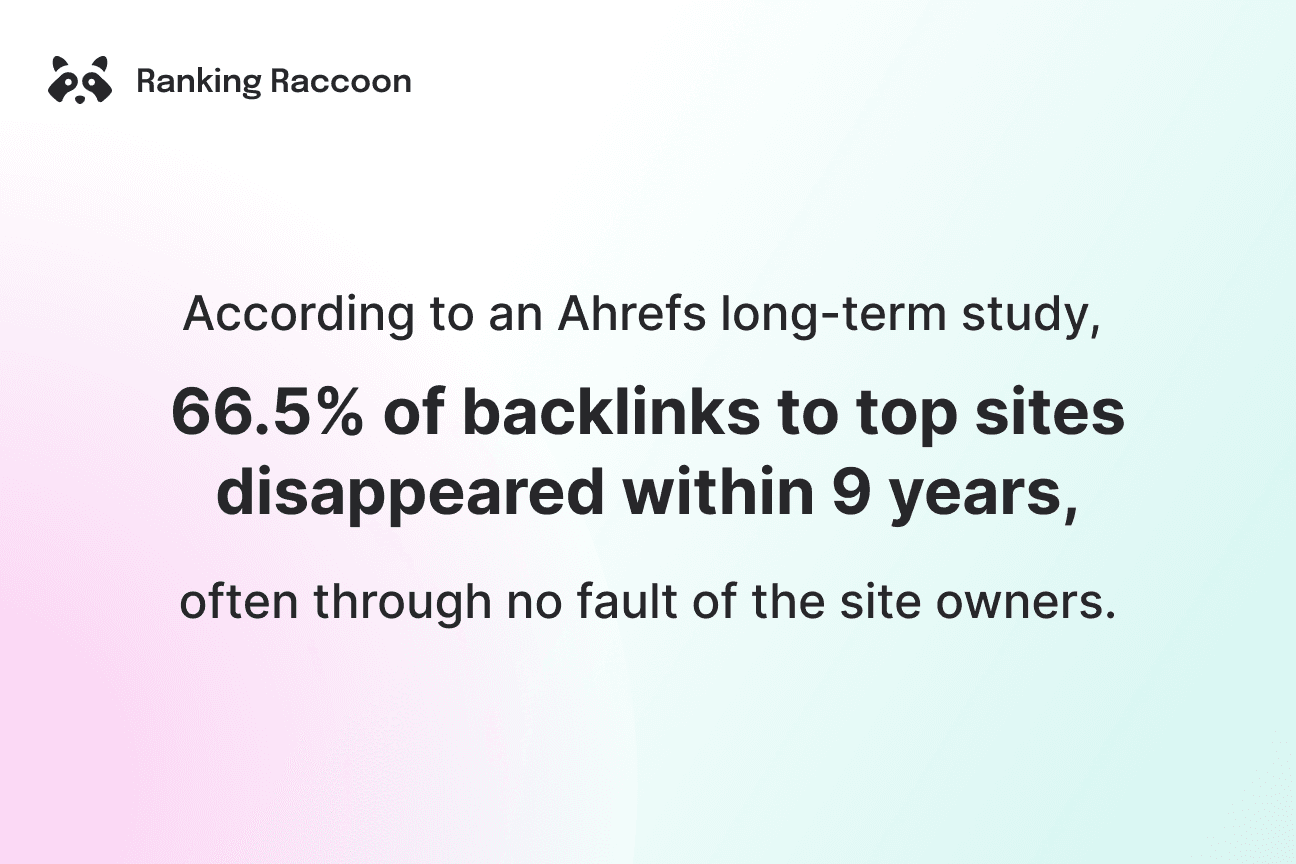
Studies show that 20–30% of backlinks disappear or lose value every year, often due to site updates, migration errors, or content changes.
By switching the Lost filter on, you can check why your links disappeared:
- 404 pages
- content removed
- redirects
- noindex tags
- site migrations gone wrong
2. Staying in Control with Continuous Monitoring & Alerts
A backlink audit gives you a snapshot of where you stand today, but it expires quickly. Your link profile is a constantly shifting, living system. That’s why the moment your audit is complete, the next responsibility is keeping that baseline under control.
Top agencies track:
- Weekly, they review new links, lost links, and emerging toxic patterns.
- Monthly, they evaluate anchor text trends, domain trust shifts, and long-term link stability.
- And through real-time alerts, they catch suspicious events the moment they occur.
Basically, while the audit shows you the health of your backlink profile, monitoring is what keeps it alive, stable, and protected.
3. Recovering Lost Value with Backlink Reclamation
Once your audit and monitoring reveal where authority is leaking, backlink reclamation becomes your fastest path to restoring lost value. It is often the highest-ROI move in the entire backlink management workflow.
Fixing lost links caused by site changes
During redesigns, URL restructures, or updates, pages frequently move or break. External links pointing to those URLs still exist—they just lead nowhere. Updating redirects or restoring content instantly recaptures authority you’ve unintentionally abandoned.
Restoring links broken during CMS updates
Migrating from WordPress to Webflow, changing slug logic, or cleaning up category structures often leads to thousands of unintentional 404s. These represent recoverable backlinks. A quick redirect map can revive years of accumulated link equity.
Reclaiming unlinked brand mentions
Moz found that over 70% of brand mentions on the web do not include a link—but many can become backlinks with a simple outreach email.
Finding these mentions (via Ahrefs, Semrush, or Google Alerts), confirming relevance, and requesting a link is so easy, a perfect low-effort task for a lazy Friday afternoon at work.
Replacing competitors’ broken backlinks
If a competitor’s high-authority link now points to a dead page, that’s an opportunity. Offer a better, up-to-date resource as a replacement. Publishers prefer fixing broken outbound links, and you gain a backlink they previously owned.
4. Unlocking New Growth with Opportunity Sourcing
Once your backlink profile is stable, healthy, and efficiently monitored, the focus shifts from defensive maintenance to strategic expansion. Opportunity sourcing is where backlink management becomes proactive and all about identifying where new, trustworthy authority can be earned.
How to do opportunity sourcing?
Discovering competitor backlink patterns
By analyzing which pages, formats, or partnerships consistently earn links for your competitors, you can identify repeatable models. If three competitors earn links from the same industry publications or resource pages, odds are you can too.
Identifying emerging domains in your niche
New blogs, newsletters, review sites, and topical hubs appear constantly. Early outreach to rising, high-fit domains often results in long-term, high-trust relationships before they become saturated.
Winning editorial link placements
Editorial links earned through original research, expert commentary, thought leadership, or high-quality tools/resources remain some of the strongest link types. They definitely move the needle and signal credibility to Google.
Forming white-hat, collaboration-driven partnerships
Modern SEO isn’t just about link swaps anymore; it’s shifting decisively toward white-hat, collaboration-driven partnerships that create real, mutual value. Platforms like Ranking Raccoon, a networking site designed for smart and ethical backlink exchange, make these authentic collaborations far more scalable, allowing teams to grow authority through meaningful, trust-based relationships.
Now that we’ve mapped out what effective backlink management should look like in 2026, the question becomes: how do you operationalize it without drowning in doing link building and backlink management simultaneously?
How Ranking Raccoon Supports Your Backlink Management
Ranking Raccoon makes all of it dramatically easier. Instead of hunting through endless spreadsheets, manually checking domain quality, or juggling chaotic outreach threads, Raccoon gives you a single, streamlined environment for discovering new partners, managing collaborations, and tracking the links you build on the platform.
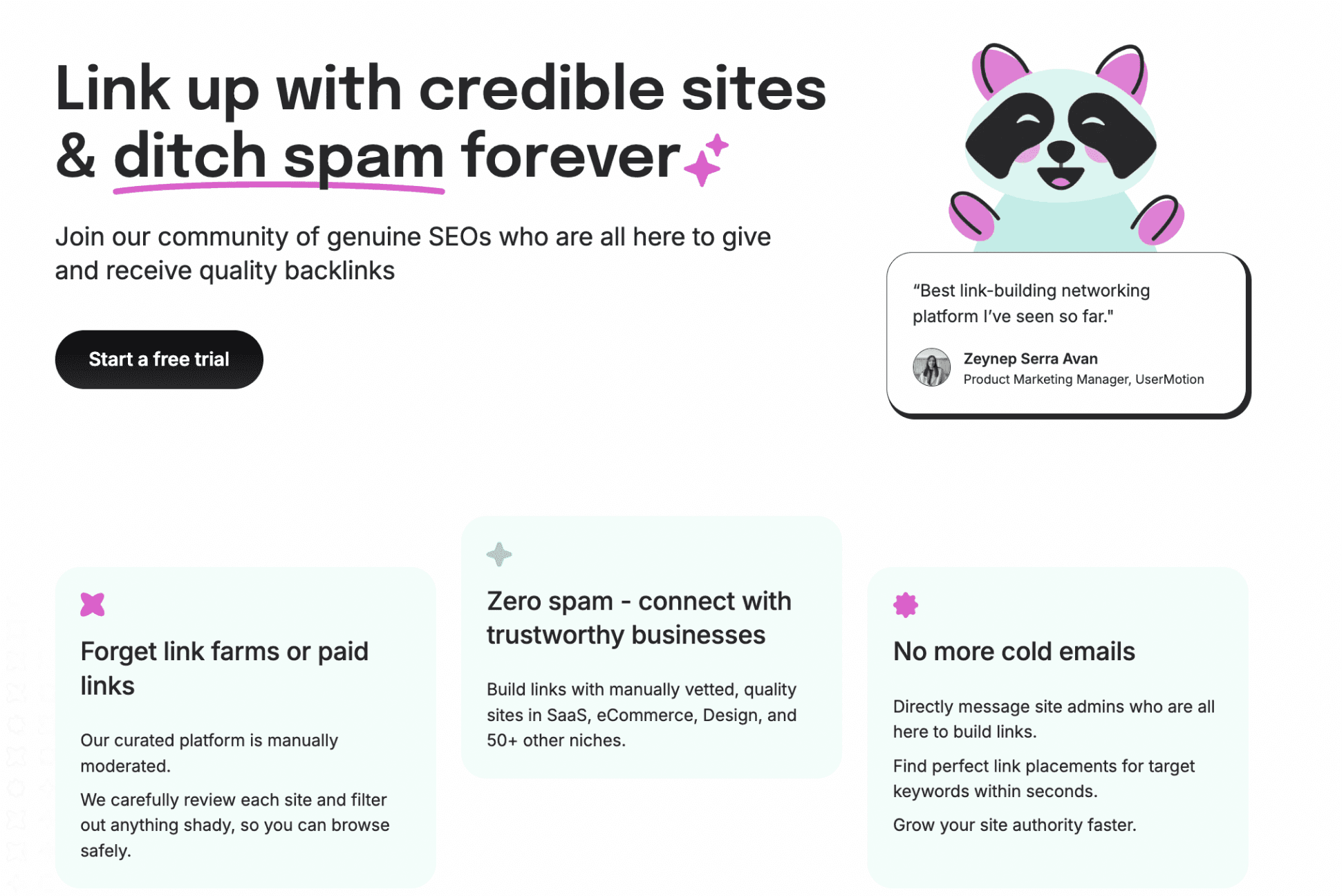
Discover high-quality link opportunities instantly
One of the biggest advantages of using Ranking Raccoon is how effortlessly you can find new opportunities. Because every site on the platform is manually vetted and enriched with Ahrefs metrics, you never have to waste time checking DR, traffic, spam signals, or hidden PBN footprints. Low-quality sites, link farms, and paid-link schemes simply cannot enter the system.
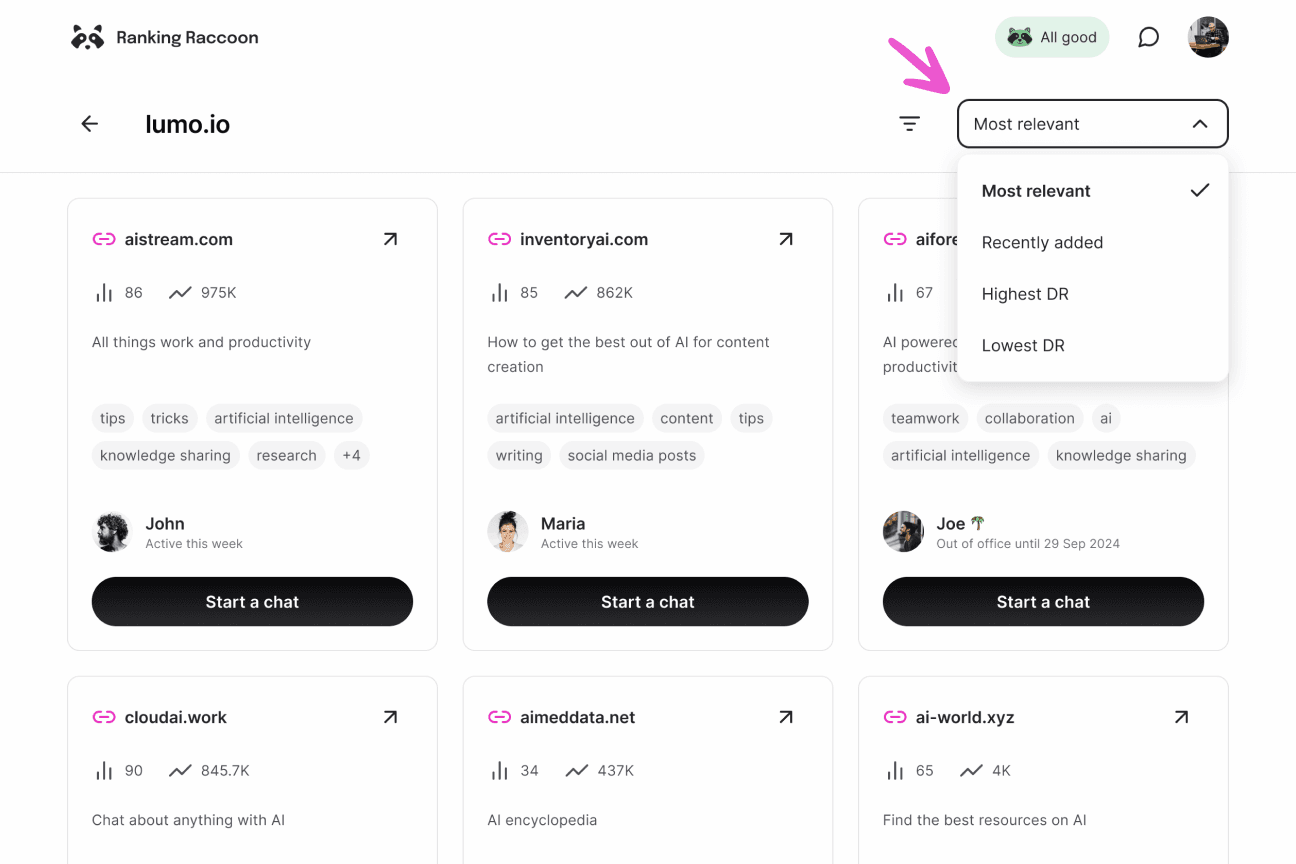
Powerful filters that surface the right partners fast
You open Raccoon, apply a few filters, and instantly see real, collaboration-ready partners in your niche. The filtering system is intentionally simple but surprisingly powerful: you can sort sites by relevance, DR range or recency. In the end,you’re left with a curated shortlist of websites that actually want to collaborate and are actively open to ethical link partnerships.
Easier collaboration through built-in chat
Communication is just as frictionless: instead of juggling email threads or chasing replies, everything happens through Raccoon’s built-in chat — faster, cleaner, and specifically designed for link collaborations. Once a link is placed, you don’t need to manually verify whether it’s live or dofollow—Raccoon automatically confirms link status.
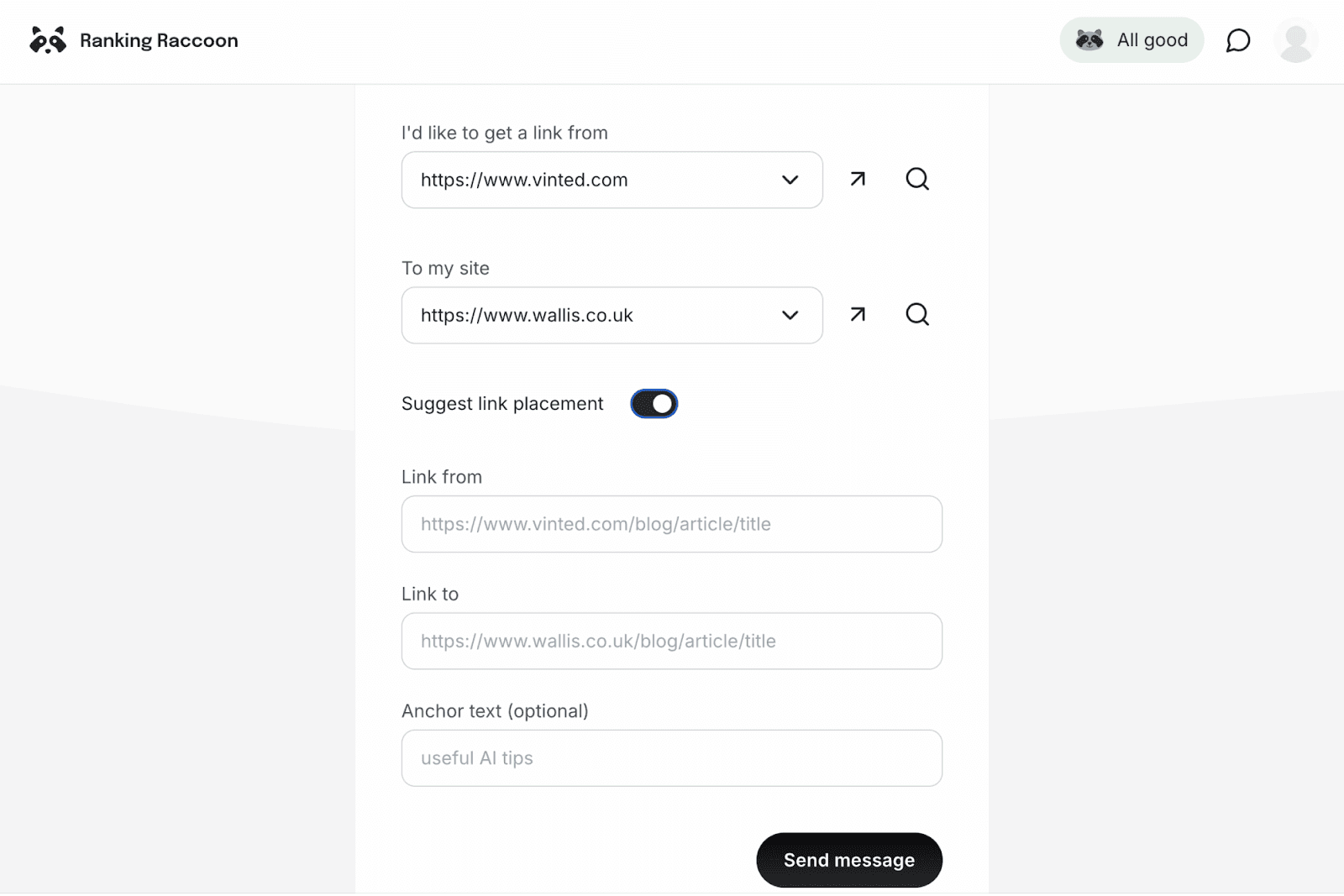
Track backlinks without spreadsheets
But the platform doesn’t stop at discovery or communication—it also removes one of the biggest operational pains: link tracking. The built-in Link Tracker replaces messy spreadsheets entirely, showing you every backlink you’ve built inside the platform, along with the domain’s DR, traffic, placement date, and even the contact person who helped make it happen.
Keep your backlink profile clean by default
Another major advantage of finding partners through Raccoon is that your backlink profile stays inherently cleaner. Because the platform only lists manually vetted, high-quality, non-spam domains, you’re never exposed to shady link farms, hidden PBN networks, or low-trust sites that could quietly damage your authority. Instead of spending time rejecting bad prospects, you only ever interact with collaboration opportunities that already meet strict quality standards.

The KPIs That Actually Matter in Backlink Management
Regarding the KPIs that matter most in backlinks management, the key question is:
How to measure stability, relevance, and long-term trust?
- The first critical KPI is Referring Domain Velocity:
This measures how consistently new, high-quality domains are added to your profile. Google’s systems look for natural, steady acquisition patterns, sudden spikes or long droughts often signal manipulation or stagnation.
- Next is Topical Relevance Score:
It reflects how closely your backlinks match your site’s subject matter. As Moz and Ahrefs repeatedly highlight, relevant links outperform high-DR irrelevant ones because they strengthen your site’s semantic authority in Google’s knowledge graph.
- Another essential KPI is Link Health & Stability:
A combined measure of lost links, redirect chains, linking page updates, and overall link durability. Ahrefs’ long-term study on link decay showed that a significant portion of backlinks naturally disappear or lose value over time — meaning authority quietly leaks unless you reclaim or replace lost assets.
- You should also track Anchor Text Naturalness:
A balanced anchor profile signals real editorial intent and should include: branded anchors (“YourBrand”), URL anchors (“yourbrand.com”), partial-match anchors (“best SEO tools for beginners”), generic anchors (“click here”), and occasional exact-match anchors. Too many exact-match anchors can trigger Google’s spam detectors or cause algorithmic downgrades.
- Finally, agencies monitor Trust-Weighted Authority Distribution:
Which pages receive links, how authority flows internally, and whether critical landing pages actually benefit from inbound signals. A site with the same number of backlinks can perform wildly differently depending on how link equity is allocated.
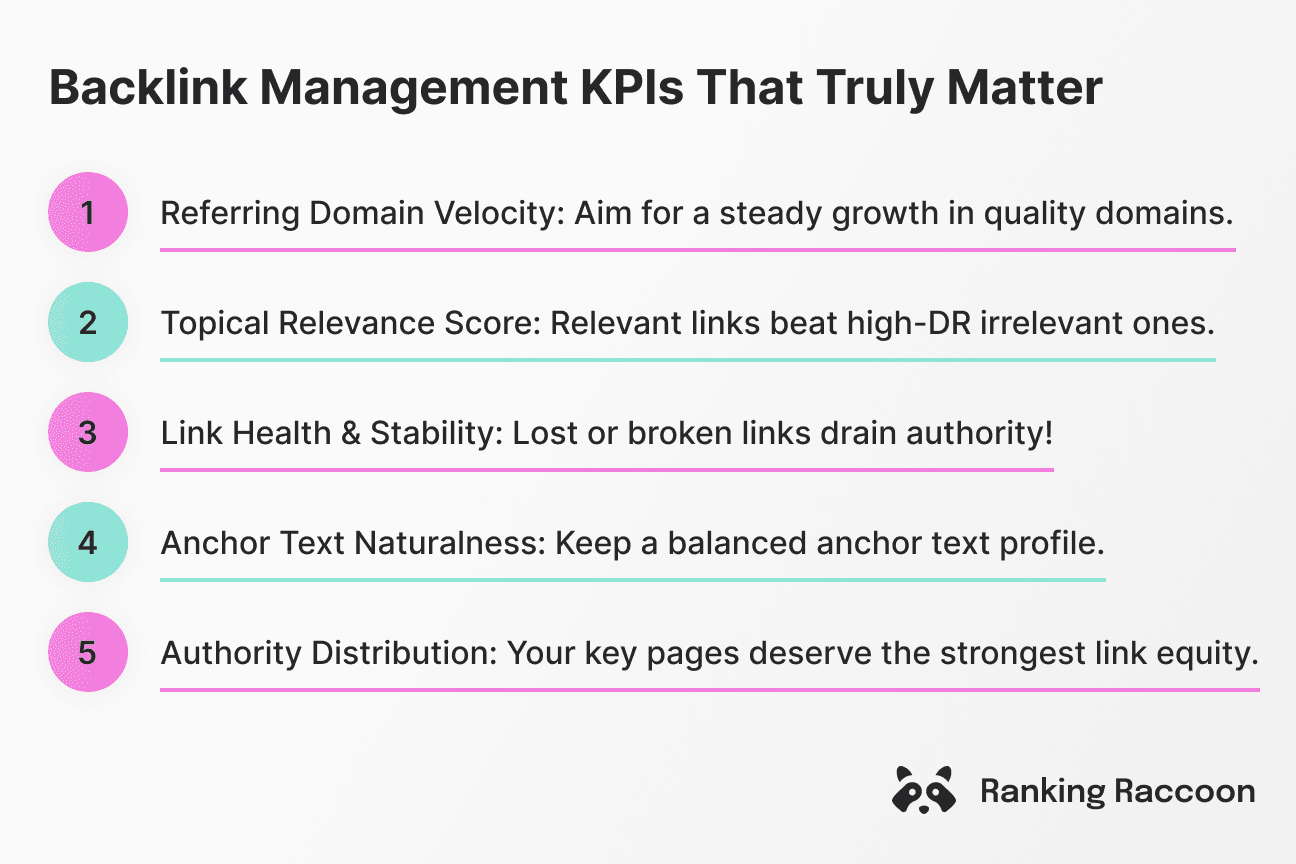
Together, these KPIs tell you whether your backlink profile is growing strategically, eroding silently, or sending mixed trust signals. They are the difference between a profile that compounds authority over time and one that becomes increasingly fragile with every update.
Most Common Backlink Management Mistakes (and What to Do Instead)
Shaping and working on your backlink profile is a lengthy process. But with that comes a huge advantage; the sinking also happens slowly and usually because SEOs make the same predictable mistakes over and over again. Remember, you can turn things around! Just change your backlink management method if any of these statements resonate with you:
"I chase DR instead of relevance."
A link from a high-DR but off-topic site often contributes little (or nothing) to your rankings, while a smaller but topically aligned domain can strengthen authority much more effectively.
"I don’t care about anchor text diversity."
Over-optimised anchors (especially exact-match clusters) can signal manipulation. Even if your links come from legitimate sites, unnatural anchor patterns can trigger Google’s link spam systems.
"I rarely look at my existing backlinks."
Teams also run into trouble by treating backlink monitoring as a quarterly housekeeping task, when it should be an ongoing operational discipline. Lost links, redirect chains, and toxic link injections accumulate quietly. Ahrefs’ research shows that a significant portion of links naturally rot or disappear over time, which means unmanaged profiles steadily lose authority unless someone actively intervenes.
"I only rely on one source of link building."
You only do guest posts or only directories. Profiles built from one link type look unnatural and lack the contextual diversity Google expects in real editorial ecosystems.
What to do instead? Build relevance-first links, maintain a natural anchor distribution, monitor your profile weekly, diversify your acquisition methods, and regularly review the quality of linking pages. Backlink management isn’t just fixing problems, it’s continually shaping a link profile that compounds trust.
Key Takeaways: Manage Your Backlinks as Assets
Backlinks in 2026 are going to be long-term strategic assets. The sites winning today aren’t just building links; they’re managing every part of their backlink ecosystem with intention, precision, and consistency. When you maintain relevance, protect link health, diversify acquisition channels, and prioritise genuine collaboration, your backlink profile becomes a competitive advantage that compounds month after month.
And while the framework in this guide gives you the “what” and “how,” Ranking Raccoon gives you the “do it without drowning in work.” It streamlines partner discovery, simplifies communication, and keeps your backlink profile clean by default. In a landscape where Google’s standards rise every year, having a curated, trustworthy ecosystem of collaborators becomes a superpower—one that Raccoon makes accessible to every link builder.

Backlinks Management FAQ
What is backlink management?
Backlink management is the ongoing process of tracking, evaluating, improving, and maintaining your website’s backlink profile. It includes monitoring new and lost links, identifying toxic backlinks, keeping anchor text natural, reclaiming broken links, and prioritizing high-quality link opportunities. In practice, backlink management ensures your link profile stays healthy, relevant, and aligned with Google’s guidelines, rather than decaying or becoming risky over time.
Are backlinks still important in 2026?
Yes, backlinks are still crucial in 2026. While Google has become more sophisticated in evaluating link quality, high-relevance, high-trust backlinks remain one of the strongest indicators of authority. What has changed is how Google interprets them:
- relevance > raw DR
- editorial placement > sidebars
- natural patterns > manipulation
- stability > volume
Backlinks matter, but managed backlinks matter even more. A well-maintained backlink profile leads to stronger topical authority, better E-E-A-T signals, and more resilient rankings.
What are the three types of backlinks?
The three primary types of backlinks are:
- Natural backlinks: Links you earn organically because someone found your content valuable (e.g., a blogger references your guide without you asking).
- Manual or outreach-based backlinks: Links you obtain through proactive outreach, collaborations, guest posts, digital PR, or link exchanges—the backbone of most SEO strategies.
- Self-created backlinks: Links you place yourself (e.g., forum profiles, business directories, comments). These hold the least SEO value and should be used sparingly to avoid spam signals.
How do you monitor backlinks?
You monitor backlinks by using SEO tools that track new, lost, and changed links in real time. Tools like Ahrefs or Semrush alert you when a link goes live, changes from dofollow to nofollow, disappears, or comes from a suspicious domain. Effective monitoring also includes reviewing anchor text trends, checking linking-page relevance, and confirming link health monthly or weekly depending on your scale.
What is a toxic backlink?
A toxic backlink is a link that comes from a spammy, low-quality, or manipulative website that can harm your site’s trust signals. Common toxic sources include PBNs, link farms, automated content sites, hacked domains, irrelevant foreign-language domains, or pages with aggressive exact-match anchor stuffing.
How often should you perform a backlink audit?
Most SEO teams run a light backlink audit monthly and a deep, full audit every 3–6 months. Large sites or fast-moving industries may need weekly checks. The key is consistency: backlinks change constantly, and issues like link rot, spam injections, or anchor over-optimization are easiest to fix when caught early.
Eliza Forgacs
Marketing Manager