
Relevant Link Building: What Does It Mean in 2026?

Eliza Forgacs
A question that keeps coming back in the SEO world:
Is link building dead?
And the answer hasn’t changed: no. But do you want to know what is actually dead in 2026?
Building your link strategy on numbers in a spreadsheet. Counting your backlinks like Scrooge McDuck counts his dollars. Gathering spam and paying for big promises wrapped in link packages.
In today’s SEO landscape, relevance is the difference between links that help you rank and links that quietly hurt you. In this article, we’ll break down:
- what relevant link building actually means,
- why Google cares about relevance more than ever,
- a practical 6+1 step workflow,
- and how to build links safely and efficiently (aka the Ranking Raccoon way).
Let’s uncover what relevant backlinks really look like.
What Is Relevant Link Building?
Your relevant links are the ones that make sense.
If a human reader who’s actually interested in the topic would pause and wonder why that link is there, Google will likely do the same.
So, relevant link building is the practice of acquiring backlinks that actually make sense for users, for search engines, and for the content they appear in.
The core value behind relevant links is that they’re contextually justified. They:
- come from websites that cover similar topics,
- appear in content environments that naturally support the link,
- and reach an audience that could realistically benefit from clicking.
And now let’s take a closer look at…
What Makes a Link Relevant?
Although at first glance it seems simple, relevance isn’t just a checkbox you tick. It’s a combination of signals that together answer one simple question: does this link belong here? Google evaluates relevance in context, relationships, and intent. When those line up, a link becomes a meaningful trust signal and ranking factor.
The first and most obvious layer is topical relevance.
A link is relevant when it comes from a site (and more importantly, from a page) that talks about similar subjects. Google understands topical neighborhoods.
Good example:
A technical SEO guide linking to a keyword research tool while explaining how to evaluate ranking potential.
Bad example:
An unrelated news site inserting a link to an SEO tool inside a sponsored paragraph with no topical connection.
The next layer is audience relevance, which is often overlooked.
Even when two sites target similar keywords, relevance doesn’t automatically follow. The real question is whether they’re written for the same kind of reader.
A link is far more valuable when it reaches people who could realistically care about your product, content, or solution. If the overlap between readers is minimal, the link may not carry the wished weight or trust.
Good example:
A startup growth newsletter referencing a link building solution while discussing scalable SEO strategies.
Bad example:
A hobby blog casually linking to a professional marketing solution its readers are unlikely to ever use.
Finally, there’s relevance in user intent.
The most subtle but increasingly important factor. A relevant link supports what the reader is trying to achieve at that exact moment. It helps them learn more, make a decision, or take the next logical step. When a link aligns with intent, it feels truly helpful.
Good example:
A comparison post about SEO tools linking to a specific feature page or demo when readers are clearly evaluating options.
Bad example:
A high-level strategy post linking to a pricing page when the reader is still in the learning phase.
Once you understand what makes a link relevant (topic, audience, and intent) the next logical question is: Where do these links actually come from?
Where to Find Your Relevant Links?
Relevant links are usually found where relevance already exists. Where would your link feel like a reference and where would it be an interruption?
Industry blogs, niche websites, podcasts and any ecosystem close to your business can be a “natural” home for a relevant backlink.
If a site already publishes content related to your topic, speaks to a similar audience, and aligns with the same user intent, your link fits by default. No forcing, no stretching, no deluding ourselves.
6+1 Steps Workflow for Relevant Link Building
Relevant link building isn’t complicated, but it does require discipline. The difference between links that work and links that don’t usually comes down to whether you followed a clear process or just reacted to opportunities as they appeared.
Step 1.: Define the core topic and page intent
Everything starts here. Before you think about links, you need absolute clarity on what the page is about and why it exists.
Is the goal to educate, compare, or convert? Without a clearly defined topic and intent, relevance becomes almost impossible to judge.
Step 2.: Map the surrounding topic cluster
Your relevant links live within a broader topic ecosystem. Map out the concepts, questions, and subtopics your audience naturally explores before and after landing on your page.
This helps you understand where your content fits, and which external pages would logically reference it.
Step 3.: Identify websites inside the same topic space
Now look for sites that already operate within this ecosystem. At this stage, authority is secondary. Relevance comes first.
This means a smaller site deeply focused on your niche will often pass stronger signals than a high-authority site that only touches your topic superficially.
Step 4.: Evaluate links through three relevance lenses
Before pursuing a link, check it against the relevancy three criteria:
- topical alignment,
- audience fit,
- and user intent.
Relevant links perform because all three layers reinforce each other.
Step 5.: Create content worth referencing
Only now does content come into play. Relevant links are rarely placed into thin or generic pages. They live inside deeper content that offers real value: insights, data, explanations, or practical guidance.
If your page doesn’t deserve to be cited, even the best outreach message won’t save it.
Step 6.: Approach outreach as a logical addition
When relevance is in place, outreach stops feeling like persuasion. You’re no longer asking for a favor, you’re now proposing a mutually beneficial and logical improvement.
Try to think in longer term goals and build partnerships alongside the way. These shifts in mentality alone dramatically increase success rates.
As a Reddit User put:
"Link building feels way more relationship-based this year. I’ve been leaning into creating small assets that are actually useful to niche communities, then finding ways to share them in places where they’d naturally get picked up. Not just blog posts, but things like data roundups or frameworks people can reuse."
Read the full thread here.
+1: Measure impact, not link volume
Finally, track what actually matters. One relevant link that strengthens your topical authority and drives qualified traffic is worth far more than ten links that only inflate a spreadsheet. In modern SEO, quality over quantity—always!
A Quicker Way to Relevant Links: Ranking Raccoon
Following a relevance-first workflow works, but doing it entirely manually takes a lot of time. Finding the right sites, verifying that they’re truly relevant and safe, and then reaching out to the right people. It can quickly turn into a slow, fragmented process with plenty of frustration.
Ranking Raccoon offers a faster solution. Our tool is built around a curated community, where every site is manually vetted before joining, with checks on metrics, traffic, backlink profiles, and content. The goal is to filter out spammy, low-quality, or PBN-like entries early.
After registering you end up with a curated pool of sites that are already aligned with your niche. Our filtering options effectively reduce the prospecting phase without removing human judgment from the process.
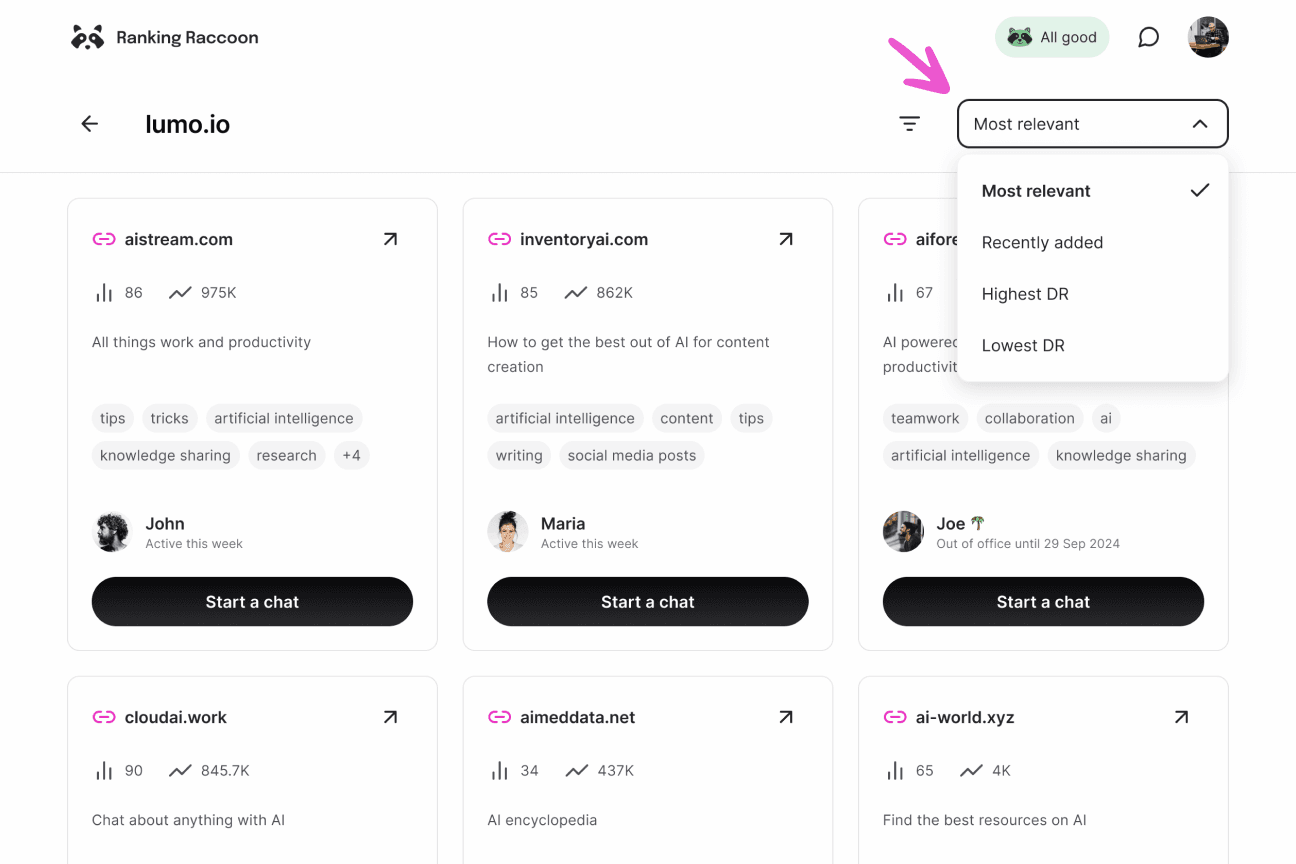
What makes the community especially effective is shared intent. Everyone is there for the same reason: to build links. That shared goal changes the dynamic entirely. Instead of cold outreach and guesswork, community members can communicate directly with each other through in-platform chat, starting conversations where relevance and willingness already exist.
In short, Ranking Raccoon helps you focus on the question that matters most in modern SEO:
Does this link belong here?

How Important Is Relevancy Exactly in Link Building?
Search engines no longer reward links simply for existing; they evaluate whether those links actually belong in the context where they appear.
Backlinks still influence rankings in 2026, but how and why they do so has fundamentally changed. Relevance is no longer just a “nice to have”. It has clearly become a deciding factor in whether building a backlink is truly worth your time and effort, or merely adds another number to a spreadsheet.
This shift is clearly reflected in the data. Industry-wide SEO studies consistently show that top-ranking pages earn significantly more backlinks than pages ranking lower in the SERPs. On average, pages in the top positions receive 3.8× more backlinks than those ranking between positions two and ten.
The same pattern appears when looking at traffic. Pages with 100+ backlinks generate up to 3.2× more organic traffic on average than pages with fewer links, showing that backlinks don’t just support rankings—they also attract real, qualified visitors.
Common Mistakes To Avoid in Relevant Link Building
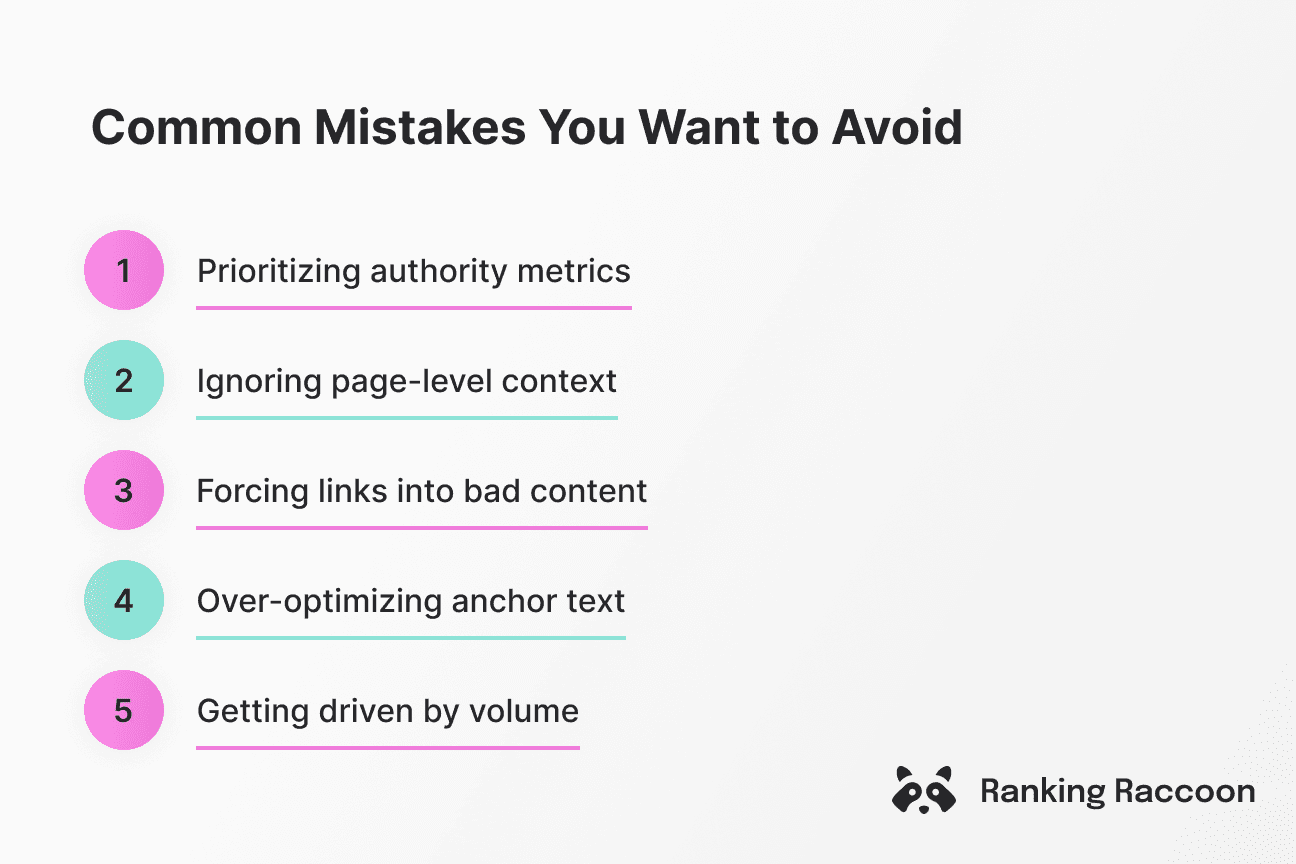
Prioritizing authority metrics
A high DR or DA score can look impressive in a report, but if the linking site operates outside your topic space, the SEO impact will be limited. Authority amplifies relevance (doesn’t replace it.)
Ignoring page-level context
A relevant domain doesn’t automatically guarantee a relevant link. If the specific page hosting the link isn’t aligned with your topic or user intent, the backlink loses much of its value. Google evaluates where a link lives, not just where it comes from.
Forcing links into bad content
Thin pages, generic articles, or purely promotional content rarely deserve editorial links. When content doesn’t provide real value, outreach becomes harder and link placement looks unnatural.
Over-optimizing anchor text
This is a classic issue. Exact-match anchors used repeatedly can turn even relevant links into risk signals. Natural language, branded, or contextual anchors tend to perform better and age more safely.
Getting driven by volume
treating link building as a volume-driven process instead of a relevance-driven one often leads to wasted effort. Mass outreach, generic pitches, and “link packages” may increase link counts, but they rarely strengthen topical authority.
Conclusion: Relevant Links Are the Ones That Last
What still works in 2026 is relevance: links that make sense in their context, serve a real audience, and support user intent instead of interrupting it.
Relevant links come from understanding topics deeply, creating content worth referencing, and building relationships in the right ecosystems. When links belong where they appear, they reinforce trust, clarity, and long-term rankings.
Ranking Raccoon exists to support this relevance-first approach to link building. By bringing together a curated community of site owners who are all there with the same intent (to build links), and by filtering out spammy, low-quality, and irrelevant sites early, it helps turn relevance from a principle into a practical starting point.
Because in modern SEO, the question is no longer how many links you can get, but something far simpler:
Does this link belong here?
If the answer is yes, the results tend to last.

Eliza Forgacs
Marketing Manager